

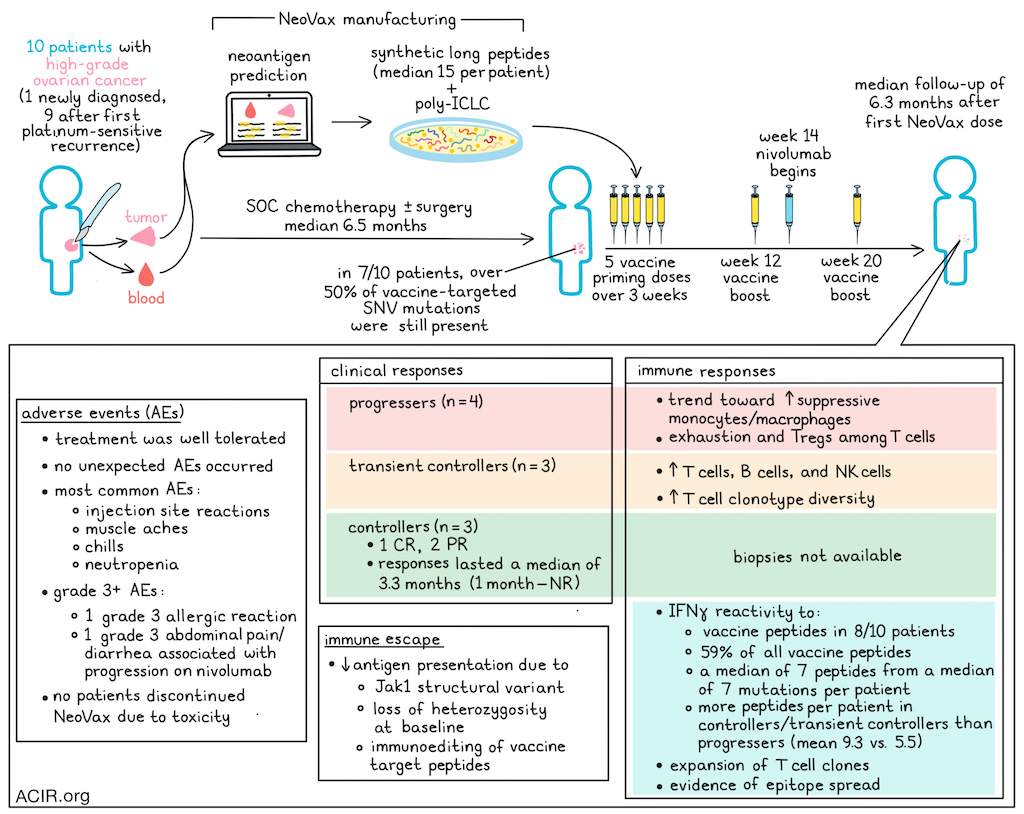
Epithelial ovarian cancers (OCs) are difficult to treat and rarely benefit from immunotherapy, likely due to poor priming. However, cancers with similarly low tumor mutation burden (TMB), have benefited from cancer vaccines. In a recent phase 1 clinical trial, Sellars et al. evaluated the use of personalized cancer vaccines in the adjuvant setting for patients with high-grade OCs treated with standard-of-care (SOC) platinum-based chemotherapy. Their results were recently published in Nature Medicine.
This trial enrolled patients with either newly diagnosed OC (Cohort A; n=9) or first platinum-sensitive recurrence (Cohort B; n=12). While a number of patients left or were unable to continue in the trial, personalized cancer vaccines were ultimately designed for 11 patients and administered to 10 (1 in Cohort A and 9 in cohort B). Following SOC chemotherapy with or without surgery, patients were treated with five priming doses of adjuvant NeoVax (synthetic long peptides admixed with the immunostimulant poly-ICLC) over 3 weeks, with booster doses at weeks 12 and 20, and checkpoint blockade treatment with nivolumab starting at week 14.
Among the 10 patients who were vaccinated, tumors harbored a median of 103 missense mutations, with a median of 86.5 encoded neoepitopes that were predicted to bind at least weakly to patient-specific HLA alleles. The personalized vaccines targeted a median of 14 mutations, consisting of a median of 15 peptides, which were distributed across 4 peptide pools per patient and delivered half subcutaneously and half intradermally at each of four injection sites.
At a median follow-up of 6.3 months after vaccine initiation, treatment was well tolerated, with no unexpected treatment-related adverse events (AEs). The most common AEs associated with NeoVax were injection site reactions, muscle aches, chills, and neutropenia. One patient experienced a grade 3 allergic reaction and another experienced grade 3 neutropenia. Another patient experienced grade 3 abdominal pain and diarrhea associated with progression on nivolumab, and was not able to receive all of the planned vaccine doses for other reasons. Ultimately, no patients discontinued treatment due to NeoVax/nivolumab-associated toxicity.
Vaccines were given a median of 6.5 months after the initial biopsy on which they were designed, during which time patients underwent SOC chemotherapy and/or surgery prior to vaccination. To evaluate whether the vaccines were still relevant to the disease at this later post-SOC time point, Sellars et al. evaluated tumor mutations using bespoke cell-free DNA (cfDNA) analysis. In 7 of 10 patients, over 50% of vaccine-targeted single nucleotide variant (SNV) mutations were still present at the time of vaccine priming, and for an 8th patient, before the last boost. Overall, 56.5% and 73.1% of target SNV mutations were detected both at priming and by the last boost, respectively, confirming that most epitopes of the vaccines maintained their relevance.
Next, the researchers evaluated clinical responses to NeoVax. Using blood-based CA125 and cfDNA-based assays to indirectly track tumor burdens, patients were categorized as progressors (progression after vaccine priming and boosting; n=4), transient controllers (progression after priming, with temporary leveling off after boosting; n=3), or controllers (prolonged disease control after priming and boosting; n=3). Among controllers, 2 achieved a complete response and 1 achieved a partial response, though cfDNA showed periods of growth and regression in these patients between days 15 and 300. Clinical responses lasted a median of 3.3 months, and ranged from 1 month to not reached.
To interrogate the immune responses induced by NeoVax and nivolumab, the researchers collected peripheral blood and performed ex vivo IFNγ ELISpot assays using treatment pools of full-length immunizing peptides. IFNγ reactivity was observed in 8 of 10 patients, most commonly peaking after the first boost. Across patients, 59.0% of peptides were immunogenic, with a median of 7 immunogenic peptides from a median of 7 mutations per patient. Notably, the vaccines for the 6 transient controller or controller patients induced responses to more vaccine target mutations than those for the 4 progressors (mean 9.3 vs. 5.5 mutations). TCR clonotype analysis also revealed expanded T cell clones after NeoVax (median 82.5) and nivolumab (median 96.5), some of which were found to be long-lived in the transient controller patients.
Single-cell RNAseq and unsupervised clustering of fresh tumor biopsies from 6 of 10 patients showed that progressors exhibited a trend toward higher intratumoral fractions of suppressive monocytes/macrophages, while transient controllers showed higher fractions of T, NK, and B cell populations. T cell populations in progressors showed a trend towards higher fractions of exhausted CD4+ and CD8+ T cells and Tregs in tumors, while in transient controllers, they showed a trend towards higher clonotype diversity. Analysis of TILs from select patients whose tumors had been profiled over time (some of which were used to generate patient-derived organoids (PDOs)) showed evidence of post-vaccine/nivolumab expansion. While TIL reactivity varied between patients, exhausted TILs were more reactive against PDOs (particularly pre-vaccine PDOs), while effector memory TILs were more reactive against known viral targets. While no NeoVax-specific clonotypes were identified among tested TILs, TIL reactivity to tumors may reflect epitope spreading. The researchers also noted evidence of a pre-existing immune response to a vaccine neoantigen, though vaccination increased the number of expanded TCRs recognizing the neoantigen, including strong expansion of higher-avidity TCRs.
Finally, Sellars et al. evaluated mechanisms of immune escape. In 1 patient, there was evidence of a JAK1 structural variant that mediated reduced antigen presentation. In 3 patients, there was a loss of heterozygosity at baseline (prior to vaccination) that could be associated with loss of an entire haplotype (covering HLA-A, HLA-B and HLA-C), and thus, a loss in the presentation of over 45% of predicted strong and week binding epitopes, including some of the best predicted epitopes. Notably, this LOH was observed in 2 of the 4 progressors. In TCGA data, LOH was observed across a variety of OC settings. Evaluation of vaccine-mediated selective pressure also revealed that for two of the transient controller patients, a number of vaccine target mutations were lost in recurrence biopsies, demonstrating immunoediting as another potential mechanism of antigen escape.
Overall, the results of this phase 1 trial demonstrate that NeoVax personalized cancer vaccines are feasible and safe in patients with OC, with early evidence of immune activity, clinical responses, and multiple mechanisms of immune escape. These results support further investigation into the potential of personalized cancer vaccines, and provides insights into how to improve vaccination strategies moving forward.
Write-up and image by Lauren Hitchings
Meet the researcher
This week, first author MacLean C. Sellars answered our questions.
What was the most surprising finding of this study for you?
In ovarian cancer, we always talk about the terrible immunosuppressive tumor microenvironment (TME) in our disease; I was initially expecting that TME to be the driving force behind resistance/evasion. So, we were struck that our data pointed to loss of antigen presentation/antigen persistence as a central mechanism of immune evasion – including pre-vaccine HLA loss of heterozygosity (LOH), loss of vaccine target mutations, and a JAK1 structural variant that reduced the presentation of at least one vaccine-target neoantigen. We think these observations both argue for on-tumor vaccine activity, and also point to an urgent need in the field to improve and refine how we choose our antigen targets to better account for heterogeneity in antigen presentation.
What is the outlook?
There have been a number of small trials like ours in recent years that suggest activity from personalized cancer vaccines (PCV) in low-tumor-mutation-burden (TMB) tumors (e.g., pancreatic, GBM, RCC). And we now have the positive results from the Interpath-001 trial, which shows benefit from adjuvant PCV with PD-1 blockade in melanoma, in a large, randomized clinical trial. It is a really exciting time to be in the field, and I think there is a ton left to learn. For low-TMB tumors, with fewer “neoantigen” shots on goal, I’m not sure that we can do exactly what was done for higher-TMB tumors, like melanomas. I think we need to go beyond canonical single-nucleotide variants (SNV) and small insertion/deletion (INDEL) neoantigens. Can we effectively identify and target neoantigens from genomic structural variants, or epitopes from ERVs, or other cancer specific translation events? Will these alternative sources allow us to increase the number of really good antigens in PCVs? And how can we do better at choosing amongst these antigens in the face of imperfect HLA-binding prediction algorithms and a substantial number of tumors with HLA-LOH (20-30% of ovarian tumors, higher numbers in some other diseases)? There are surely also changes that we can make in our adjuvants to augment and shape T cell responses, and in co-therapies to support these T cells as they enter the TME.
Who or what has been a major source of inspiration or motivation for you throughout your career?
I think I’ve been incredibly lucky to have amazing mentors from graduate school, through a first post-doc, to my more recent clinical and translational training. They have all been supremely collaborative, and that has been one of the most important lessons – you really have to collaborate and share to get big and important science done.


