

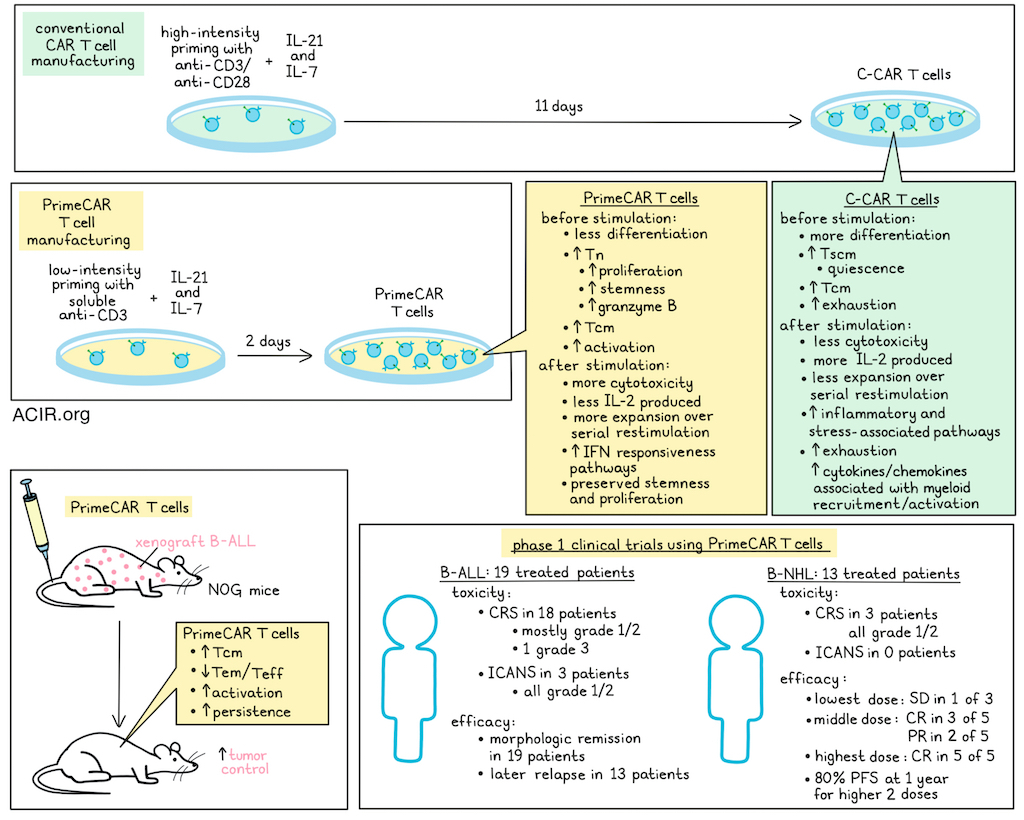
CAR T cells are a powerful treatment option for certain cancers, but their use can be limited by long manufacturing times and severe toxicities. In order to overcome these hurdles, Yang and Li et al. developed a new CAR T cell manufacturing protocol called PrimeCAR involving low-intensity priming with cytokine support and limited expansion to optimize the quality of the CAR T cell product and improve patient outcomes. Their research was recently published in Cell Stem Cell.
To begin, Yang and Li et al. compared a 2-day protocol of low-intensity priming using soluble anti-CD3 against a 2-day protocol of conventional CD3/CD28 stimulation. While proportions of CD4+ T cells, CD8+ T cells, and CAR+ T cells were similar between groups, as was cytotoxicity, the low-intensity priming protocol yielded reduced expression of activation markers, including CD25, CD69, and CD137, and reduced levels of inflammatory cytokines, including IFNγ, IL-2, and TNFα. Over the course of serial rechallenges, both products showed similar expansion and differentiation trajectories. Further, the two groups showed similar tumor control in a xenograft model (including upon rechallenge) and similar CAR T cell survival in peripheral blood.
Based on these results, the researchers established a 2-day protocol called PrimeCAR in which T cells were primed ex vivo with low-intensity soluble anti-CD3 in combination with IL-7 and IL-21, which have been shown to support stem cell memory and enhance tumor control. This protocol was compared against a conventional 11-day manufacturing protocol (C-CAR) involving standard CD3/CD28 stimulation supported by IL-7 and IL-21. Compared to C-CAR T cells, PrimeCAR T cells maintained an earlier differentiation profile and were enriched for naive (Tn) and central memory (Tcm) populations. Co-inhibitory marker expression in PrimeCAR T cells was more consistent with an activation profile than a terminal exhaustion profile. Finally, PrimeCAR T cells produced lower levels of inflammatory, myeloid-attracting, and activating signals.
Looking at cytotoxic potential, PrimeCAR cells outperformed C-CAR T cells in target cell killing assays across effector-to-target ratios, even though PrimeCAR T cells produced less IL-2, and both groups produced similar levels of IFNγ. In serial restimulation assays, PrimeCAR T cells continued to expand over repeated rounds, while C-CAR T cell expansion plateaued early and became limited in later rounds, ultimately resulting in greater cumulative expansion in the PrimeCAR group.
In a NOG xenograft model of B-ALL, PrimeCAR T cells showed stronger and more durable tumor control and were maintained at higher levels in peripheral blood over time, even at lower doses compared to C-CAR T cells. At 28 days post-infusion, PrimeCAR T cells from peripheral blood showed a higher proportion of Tcm cells, a lower proportion of Tem/Teff cells, and higher expression of activation markers. Expression of exhaustion markers was similar between groups.
Moving towards clinical applications, the researchers evaluated CAR T cell products generated from two independent donors. Using scRNAseq, they found that while C-CAR products were enriched for conventional Tscm-like and Tcm subsets, PrimeCAR products demonstrated a distinct primed Tn-like state, with high expression of genes related to stemness, proliferation, and granzyme B. Cell cycle analysis showed evidence of more active proliferation of PrimeCAR Tn-like cells, while C-CAR Tscm cells were more quiescent. Similar results were confirmed at the protein level and in trajectory analyses.
Next, the researchers evaluated their donor-derived CAR T cell products after 24 hours in co-culture with target Nalm6 cells and found that the two manufacturing protocols resulted in different post-stimulation response profiles. While PrimeCAR cells were enriched for IFN-responsive and proliferative programs (IFNα/γ responses, E2F targets, G2/M checkpoint, and mTORC1 signaling), C-CAR cells were enriched for inflammatory and stress-associated pathways, including TNFα signaling via NF-κB. Further, PrimeCAR T cells preserved expression of stemness and proliferative signatures, while C-CAR T cells upregulated exhaustion and inhibitory profiles, with broad expression of cytokines and chemokines associated with myeloid cell recruitment and activation. These patterns were maintained or further reinforced upon repeat challenges. Protein-level analyses aligned with the transcriptional findings, and showed that PrimeCAR T cell cytokine responses were lower upon initial antigen stimulation and contracted more quickly after repeat stimulation.
Given the promising in vitro and in vivo results seen with CAR T cells manufactured using the PrimeCAR protocol, the researchers initiated two phase 1 clinical trials – one in patients with relapsed/refractory B-ALL and another in patients with relapsed/refractory B-NHL. In both clinical trials, CAR T cells were successfully manufactured for all enrolled patients, though not all patients were able to be treated. PrimeCAR products were enriched for Tn-like cells and depleted of Tem/Teff cells, showing low PD-1, intermediate Tim3, and relatively high Lag3. Across dose levels ranging from 1×10⁵ to 5×10⁵ CAR+ cells/kg, no dose-limiting toxicity was observed, and most side effects were manageable and likely related to pre-treatment lymphodepletion. CRS occurred in 18 of 19 treated patients with B-ALL and 3 of 13 treated patients with B-NHL, and was mostly limited to grade 1 or 2, with only one patient with B-ALL experiencing a grade 3 CRS event. ICANS was seen in 3 of 19 patients with B-ALL and was limited to grade 1 or 2 events; no ICANS events were observed in patients with B-NHL.
Across both trials, PrimeCAR cells showed strong early expansion and long-term persistence in peripheral blood. In the B-ALL trial, all treated patients initially achieved morphologic remission and were MRD negative at the first response assessment, but 13 patients eventually relapsed, most of which were due to antigen escape. In the B-NHL trial, at the lowest dose level, 1 of 3 patients achieved stable disease, while at the second dose level 3 of 5 patients achieved complete remission and the other two achieved partial remission, and at the highest dose level, all 5 treated patients achieved complete remission. Among the 10 patients with B-NHL who were treated at the higher two dose levels, the 1-year progression-free survival rate was 80%. In most patients, circulating cytokines remained low or only transiently increased, consistent with the low rates of severe CRS and ICANS.
Overall, PrimeCAR T cells prepared with low-intensivity priming on a shorter timeline than conventional CAR T cells were less differentiated and showed an improved cytotoxic, inflammatory, and safety profiles across preclinical and clinical studies. These results support further investigation into using lower-intensity priming and shorter expansion protocols in CAR T cell manufacturing, and into utilizing the PrimeCAR protocol in later-phase clinical trials.
Write-up and image by Lauren Hitchings


