

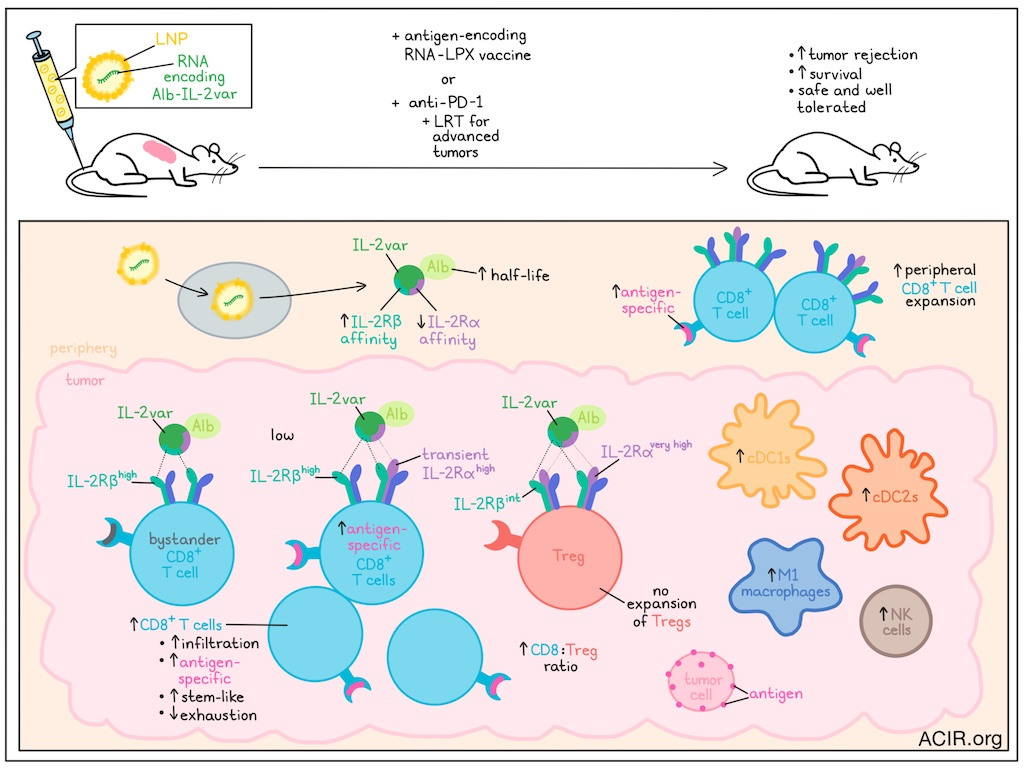
Antitumor IL-2 treatment comes with challenges regarding toxicity and unintended Treg activation. To overcome these challenges, various approaches to engineer IL-2 variants (IL-2var) have been developed. In a recent Science Advances publication, Vormehr et al. reported preclinical data on an IL-2var delivered as mRNA encapsulated in lipid nanoparticles.
The researchers aimed to identify an IL-2var that has enhanced affinity for IL-2Rβ and reduced, but not absent, affinity for IL-2Rα, thereby selectively stimulating antigen-activated CD8+ T cells (transient IL-2Rαhigh; IL-2Rβhigh) over Tregs (IL-2Rαvery high; IL-2Rβint). Mutation sets were introduced into human IL-2 and assessed for impacts on CD8+ T cell and Treg activation. HEK 293T cells were transfected with RNA encoding albumin (Alb) fusions of IL-2 and the IL-2var to improve half-life. Alb-IL-2var showed a greater potency to activate CD8+ T cells and lower potency to activate Tregs in vitro than Alb-IL-2.
The Alb-IL-2var was then used with an RNA lipid nanoparticle (LNP) platform to enable intravenous (i.v.) administration, liver uptake, and sustained expression. I.v. administration of the Alb-IL-2var RNA-LNP in BALB/c mice resulted in detectable protein in the serum within an hour, with a half-life of 23.3 hours and concentration peaking at 24 hours. In C57BL/6 mice dosed with Alb-IL-2var, peripheral CD8+ T cells expanded, with limited effects on Tregs, resulting in a higher CD8:Treg ratio than in mice treated with Alb-IL-2 RNA-LNP.
The researchers then investigated whether combining the variant with a cancer vaccine could boost expansion of antigen-specific T cells. The highly immunogenic, gp70-expressing CT26 colon carcinoma model was treated weekly with Alb-IL-2 RNA-LNP or Alb-IL-2var RNA-LNP, along with a gp70-epitope-encoding RNA-LPX vaccine (lipoplex-formulated RNA). After a single treatment, both IL-2 formulations expanded gp70-specific CD8+ T cells, though Alb-IL-2 also expanded Tregs. While the vaccine alone did not affect tumor rejection, combining it with either IL-2 formulation did, resulting in improved survival. Alb-IL-2 RNA-LNP plus the vaccine resulted in sustained tumor rejections in 63.5% of mice, whereas Alb-IL-2var RNA-LNP plus the vaccine rejected tumors in all mice, resulting in longer survival.
The treatment was then tested in the poorly immunogenic B16F10 melanoma model. Alb-IL-2 RNA-LNP or Alb-IL-2var RNA-LNP were administered weekly alone or combined with a vaccine encoding an epitope of the tumor antigen Trp. While Alb-IL-2 RNA-LNP increased Tregs, the variant did not. After two immunizations, Trp-specific CD8+ T cells became detectable in the blood, and the Alb-IL-2var RNA-LNP amplified their expansion 10-fold, whereas the original IL-2 did not. Survival was significantly improved by either IL-2 formulation (33% complete response), while the vaccine alone had no impact (0%). Combination therapy of the vaccine and Alb-IL-2var RNA-LNP resulted in longer survival (40%) than the combination with Alb-IL-2 RNA-LNP (33%).
Previous work has shown no benefit when combining IL-2 variants that lack IL-2Rα binding with immune checkpoint blockade (ICB), as bystander CD8+ T cells are preferentially expanded. Therefore, the researchers hypothesized that their variant, which retains some binding to IL-2Rα, might activate antigen-specific CD8+ T cells and thus synergize with ICB. To assess this, the researchers investigated three treatment combinations in the MC38 colon adenocarcinoma model, which has a high mutational burden and is responsive to PD-1/PD-L1 ICB. Alb-IL-2var RNA-LNP treatment alone increased intratumoral CD8+ T cells and NK cells, while Tregs remained unchanged. Within the CD8 compartment, neoantigen-specific T cells and stem-like populations expanded, and terminal exhaustion was limited.
To test combinations with ICB, mice with advanced MC38 tumors were treated weekly with Alb-IL-2var RNA-LNP and anti-PD-L1. Either monotherapy had limited effect on survival, with complete regressions observed in only 7% of mice in the Alb-IL-2var RNA-LNP group. The combination further improved survival and resulted in complete regressions in 64% of mice. Mice with even more advanced MC38 tumors were then treated weekly with the ICB and IL-2 combination plus local radiotherapy (LRT), with complete regression observed in 65% of triplet-treated mice versus 12% and 41% for LRT plus anti-PD-L1 or Alb-IL-2var RNA-LNP, respectively.
The combination of vaccination, Alb-IL-2var RNA-LNP, and anti-PD-L1 was also assessed in the TC-1 lung tumor model, which expresses the HPV16 oncoproteins E6 and E7. While E7 contains a strong CD8+ T cell epitope, it does not elicit spontaneous tumor-specific responses, and the model is ICB-refractory. A single dose of the HPV16 E7 RNA-LPX vaccine on day 13 led to transient remission and increased the median survival to 31.5 days, up from 24 days in controls. When combined with either Alb-IL-2var RNA-LNP or anti-PD-L1 starting on day 18, the survival extended to 39 days in both groups. Combining Alb-IL-2var RNA-LNP and anti-PD-L1 without vaccine had no effect on survival. The triplet therapy resulted in a median survival of 45 days, with lasting tumor rejection in 37.5% of mice. The triplet also induced the highest tumor infiltration of CD8+ T cells, E7-specific CD8+ T cells, NK cells, type 1 and 2 conventional DCs, and M1-polarized macrophages.
The researchers then performed a safety assessment in non-human primates. Naive female cynomolgus monkeys were dosed with Alb-IL-2var RNA-LNP. Treatment was well tolerated, and the pharmacokinetics were similar to those observed in mice. Further, Alb-IL-2var RNA-LNP was evaluated in repeat-dose GLP and non-GLP safety studies in mice and cynomolgus monkeys to support in-human development. Alb-IL-2var RNA-LNP was tolerated in both species at pharmacologically active dose levels. Transient circulating leukocyte reductions, cytokine induction, lymphoid hyperplasia, and Kupffer cell hypertrophy/hyperplasia were observed, but were reversible after a 3-week recovery period. There were no signals of organ toxicity or mortality. In mice, anti-drug antibodies against Alb-IL-2 and Alb-IL-2var fusion proteins were observed, and in both mice and monkeys, anti-PEG antibodies could be detected. Tolerability studies with combinations involving anti-PD-1 or RNA-LPX did not further impact safety at clinically relevant doses.
Together, these data suggest that this IL-2var overcomes toxicity and Treg-related challenges while opening the door to combination strategies with ICB and vaccination. If proven safe and effective in patients, these combinations might in future be used for the rational design of combination strategies based on the type of tumor immune microenvironment and tumor mutational status to improve clinical outcomes.
Write-up by Maartje Wouters, image by Lauren Hitchings


