

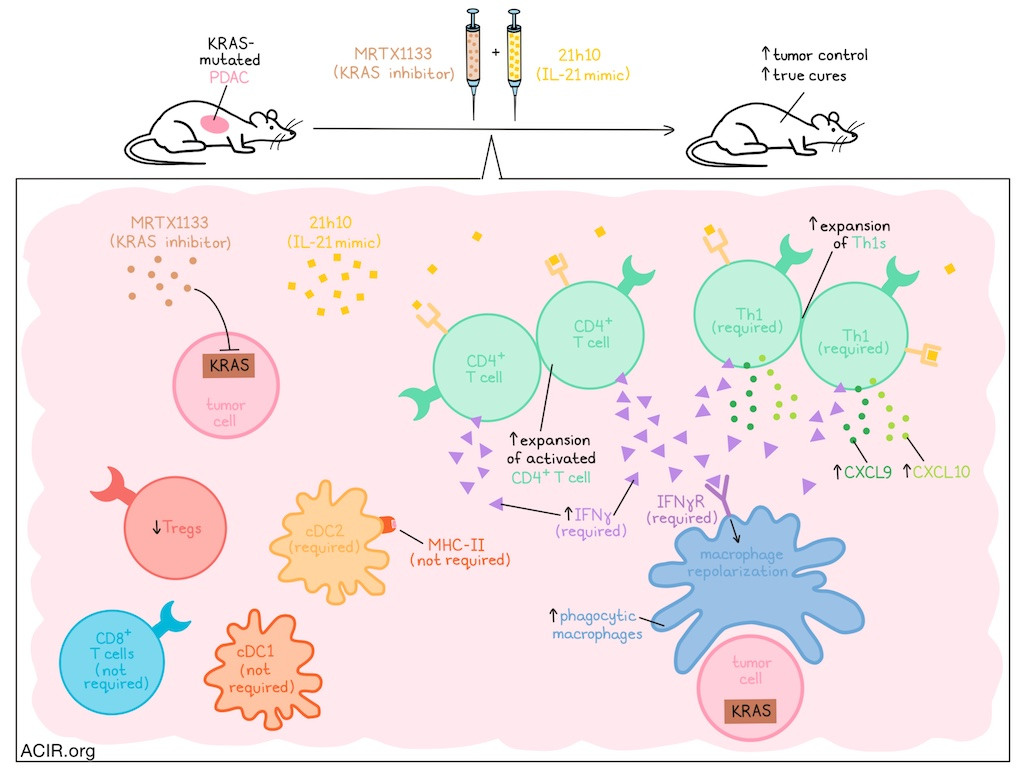
Pancreatic ductal adenocarcinoma (PDAC) has proven to be a challenge for immunotherapy treatment. KRAS inhibitors have shown efficacy in PDAC, but acquired resistance is common. In a recent publication in Cell, Qiang, Hoffman, Chun, et al. investigated whether combinations of KRAS inhibition with immunotherapy could improve long-term outcomes in murine PDAC models.
The researchers used a poorly immunogenic PDAC model in C57BL/6 mice in which 6694c2 cells are orthotopically injected to develop pancreatic tumors with low T cell infiltration that are refractory to immune checkpoint blockade (ICB). Treatment with the KRASG12D-mutation-selective inhibitor MRTX1133 for 3 days resulted in tumor regression but no changes in immune infiltrate. When mice with established tumors were treated twice daily with MRTX1133 for 17 days, there was initial tumor regression, but all mice developed recurrences within 2 weeks after treatment was stopped.
To determine whether combination with immunotherapies could result in long-term, durable remissions, various combinations with MRTX1133 were assessed. First, ICB combinations were tested, with treatment administered during the 17-day treatment period. Only a combination of anti-PD-1 and anti-LAG3 improved survival, but there were no durable remissions. Other types of immunotherapies were also screened, such as a TLR7 agonist, a cIPA1/2 antagonist, and IL-2/IL-15 (Neo2/15) and IL-21 (21h10) mimics. The IL-21 mimic was most effective for durable remissions, with 7/9 mice tumor-free at day 90. When these tumor-free mice were depleted of T and NK cells, and IFNγ was blocked to remove immune control, the mice remained tumor-free for up to 250 days, indicative of true cures.
Pancreatic cancer cells do not express the IL-21 receptor, and 6694c2 cells are not impacted when exposed to 21h10 in vitro. In vivo, monotherapy with 21h10 had activity against 6694c2 tumors, with a 50% reduction in tumor burden. The researchers then tested the combination of 21h10 and chemotherapy, as the standard of first-line care for PDAC. The combination of 21h10 and gemcitabine/n(ab)paclitaxel or FOLFIRINOX plus G-CSF led to remissions, but there were no durable responses, unlike with MRTX1133. In a model with acquired resistance to MRTX1133, the combination with 21h10 led to durable remissions in 70% of mice. This suggests that KRAS inhibition is sufficient to synergize with 21h10.
Then, to assess tumor regression kinetics, 6694c2 tumors were grown for 15 days, and mice were treated with MRTX1133 or the panRAS inhibitor RMC-6236, alone or combined with 21h10. Combination therapy resulted in more durable regressions than KRASi alone. Similarly, in KCP.1 KRASG12C-mutated lung cancer that is minimally responsive to anti-PD-1, treatment with the KRASG12C inhibitor adagrasib and 21h10 led to durable remissions in all mice.
To assess the tumor immune microenvironment (TIME), 6694c2 tumors were grown for 14 days and treated for 6 days with MRTX1133, 21h10, or the combination. Tumoral immune cells were analyzed using single-cell transcriptomics and TCR clonotype tracking. Systemic 21h10 treatment can cause pancreatitis in mice; therefore, mice also received TNF blockade (which did not affect remissions, indicating that TNF was not involved in the activity of 21h10). Combination therapy resulted in T cell expansion in the tumor, which were mainly activated IFNγ+CD4+ T cells, while Tregs decreased. Macrophages were not impacted in numbers, but there was an increase in phagocytic macrophages. TCR clonotype analysis revealed that CD4+ T cells with a Th1 phenotype clonally expanded. Further, there was an increase in gene expression of IFNγ and the IFN-response chemokines CXCL9 and CXCL10. Ex vivo, tumoral Th1 cells from mice receiving 21h10 showed increased IFNγ production.
Using depleting antibodies against CD4 or CD8 during the 17-day treatment window showed that CD4 depletion reduced survival and increased toxicity (weight loss requiring stopping treatment after 10 days), whereas CD8 depletion had no effect. To assess the role of DCs, mice lacking cDC1s (Batf3-/- mice) and cDC2s (Δ1 + 2 + 3 mice) were used. When mice lacked cDC1s, combination treatment still achieved durable remission, but lack of cDC2s resulted in severe toxicity and reduced therapy response. Further, in a model of β2m-depleted 6694c2 cells, combination therapy remained effective, and removal of Ciita from the cells to prevent upregulation of MHC-II after IFNγ exposure did not impact its efficacy. These data suggest that direct tumor cell recognition of CD8+ or CD4+ T cells is not required for therapeutic efficacy.
Intratumoral CD4+ T cells were skewed toward IFNγ-expressing Th1 cells, and the researchers hypothesized that both Th1 polarization and KRAS inhibition were essential for antitumor efficacy. To test this, the researchers used Tbx21-/- mice, which have impaired Th1 and effector CD8+ T cell development due to loss of T-bet. These mice derived no benefit from the combination treatment, suggesting Th1 cells are required. Furthermore, combination treatment was ineffective in mice lacking IFNγ. In these mice, T cell activation did occur in the tumor as induced by the combination therapy; however, repolarization of macrophages and myeloid cells via induction of MHC-II and loss of CD206 did not occur in mice lacking Ifngr1. Mice with conditional loss of Ifngr1 in macrophages had fewer durable remissions, suggesting efficacy was partially dependent on IFNγ signaling in macrophages. Further, 21h10 increased in vitro phagocytosis of tumor cells by macrophages in culture with activated CD4+ T cells.
To determine whether CD4+ T cells from patients with PDAC could respond to 21h10, PBMCs were collected pretreatment and CD4+ T cells were isolated and stimulated in vitro with anti-CD3/CD28 in the presence of 21h10. Treatment with 21h10 increased IFNγ production, as well as IL-9 (suggesting Th9 cells might be induced).
A publicly available single-cell database with 223 human PDAC samples was analyzed to determine whether human PDAC tumors might be responsive to 21h10 treatments. IL21R expression was observed in T cells, B cells, myeloid cells, and fibroblasts. Next, enzymatically digested, surgically resected tumors were treated for 24 hours with 21h10 and subjected to single-cell RNAseq. T cells increased IFNG and upregulated expression of genes associated with T cell cytotoxicity and activation, while TIGIT and FOXP3 were downregulated, suggestive of Treg loss.
Together, these data suggest that a new combinatorial strategy involving KRAS inhibitors and an IL-21 mimic may improve PDAC’s TIME, stimulating antitumor CD4+ Th1 cell responses rather than CD8+ T cell cytotoxicity. If this IL-21 mimic proves to be safe in humans, this strategy may improve outcomes by yielding more durable responses and reduced resistance to KRAS inhibition.
Write-up by Maartje Wouters, image by Lauren Hitchings


