

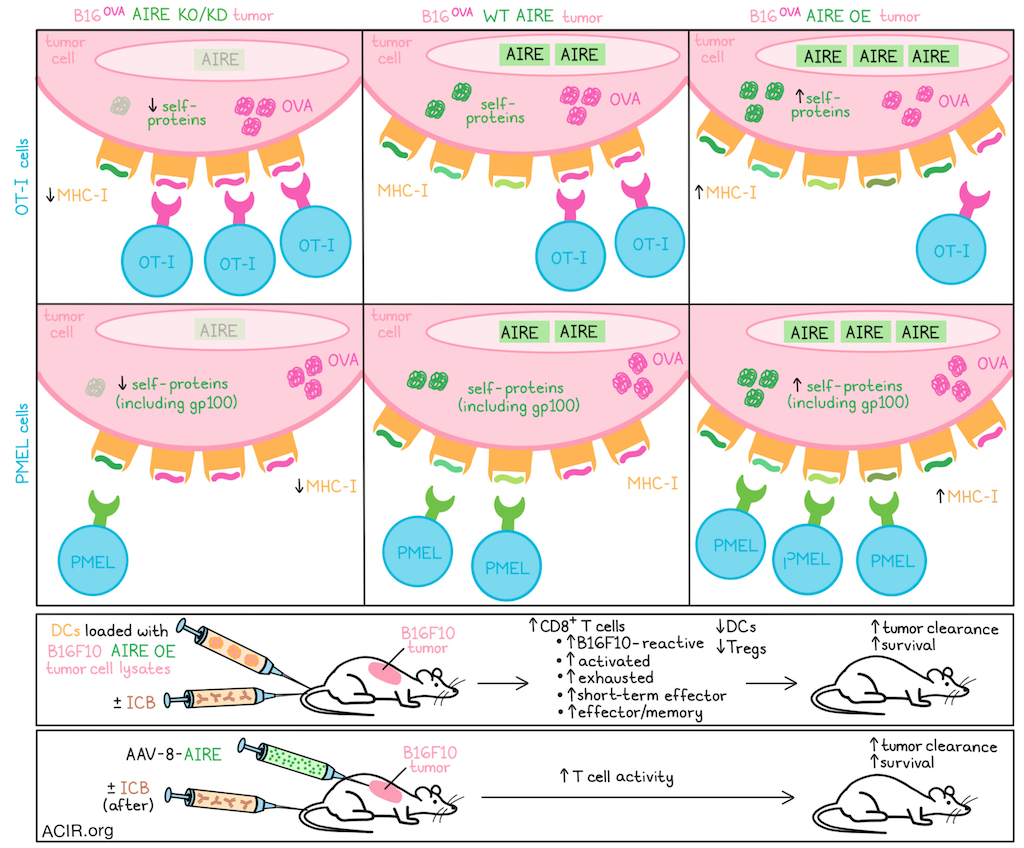
The autoimmune regulator (AIRE) transcription factor in medullary thymic epithelial cells (mTECs) is essential for the negative selection of autoreactive T cells in the thymus by inducing expression of peripheral tissue-specific antigens. Chen, Pulido, et al. hypothesized that AIRE expression in cancer cells may mimic this thymic process by establishing a “selfness” profile to evade T cell activation and recognition. In recent work published in Cancer Immunology Research, they tested whether changes in AIRE expression can be used to sensitize tumors to immune responses and immunotherapy.
OVA-expressing murine melanoma B16 cells were engineered to either knock down AIRE (B16OVA-AIREKD) via shRNA or overexpress it via lentiviral transduction (B16OVA-AIREOE). There were no significant differences in proliferation rates or OVA RNA levels between these lines and the parental lines. Levels of well-known self-proteins GAPDH, TYRP2, and CSDE1 were decreased in B16OVA-AIREKD and increased in B16OVA-AIREOE. These data suggest that AIRE modulates self-gene expression in tumors, whereas expression of genes from exogenous promoters (CMV or OVA) was independent of AIRE.
CRISPR/Cas9 was used to generate AIRE knockouts (B16OVA-AIREKO). In knockouts, surface H-2Kb decreased, whereas AIRE overexpression raised H-2Kb detection. Looking at SIINFEKL-specific presentation, AIRE knockdown significantly increased SIINFEKL levels presented by MHC-I, and stimulated OT-I cells more than parental B16OVA cells, whereas AIRE overexpression was less immunogenic to OT-I cells. This suggests that MHC-I occupancy by epitopes of the non-AIRE-mediated OVA peptide was enhanced by lower levels of self-epitopes and inhibited by higher levels of self-epitopes.
PMEL CD8+ T cells target the gp100 epitope, which is known to be regulated by AIRE in the thymus. B16OVA-AIREKD cells were unable to stimulate PMEL T cells in vitro, while B16OVA-AIREOE cells were more immunogenic than WT lines. Similarly, tumor antigen-reactive CD8+ T cells from B16-TK tumors (B16 cells overexpressing HSV thymidine kinase ) cured with ganciclovir were tested. B16OVA-AIREOE cells were more stimulatory of these T cells, and the B16OVA-AIREKD cells were less so, suggesting recognition of AIRE-mediated self-proteins. Finally, B16OVA cells escaping OT-I cells had higher AIRE levels, while those escaping PMEL T cells had lower AIRE. Thus, AIRE expression influenced T cell escape, depending on whether the antigen was AIRE-regulated.
B16OVA tumors are susceptible to adoptive transfer of naive OT-I or PMEL T cells activated in vivo by co-infection with immunogenic Vesicular Stomatitis Virus (VSV) expressing OVA or gp100, respectively. In vivo growth of B16OVA, B16OVA-AIREKD, or B16OVA-AIREOE was similar, but B16OVA-AIREKD responded better to naive OT-I cells without VSV-OVA stimulation compared to B16OVA. AIRE reduction increased recognition of non-AIRE target antigen (OVA), enhancing OT-I cell activation. Conversely, B16OVA-AIREOE cells were recognized and killed by PMEL T cells, likely due to upregulated gp100 expression and its MHC occupancy.
Based on these data, Chen, Pulido, et al. evaluated whether therapeutically changing AIRE expression in tumor cells could generate antitumor T cell responses. B16F10 tumors were mostly unresponsive to anti-PD-1 ICB, even in combination with DCs loaded with B16F10 or B16F10-AIREKD. However, DCs loaded with B16F10-AIREOE cell lysates were effective against established B16F10 tumors alone or combined with ICB. Very low levels of B16F10-reactive CD8+ T cells were detected in the spleen of mice treated with ICB and DC/B16F10 lysates, while higher levels were identified in mice treated with DC/B16F10-AIREOE with or without ICB.
To further characterize the immune response to AIRE-altered epitopes, tumor-infiltrating lymphocytes were assessed at day 20 post-tumor inoculation. Exhausted and active CD8+ T cells increased in tumors in mice treated with DC/B16F10-AIREOE, while there were fewer Tregs and DCs. Splenocytes upregulated PD-1, CD39, and KLRG1, suggestive of activation of short-term effectors, and memory subset analysis revealed predominantly effector memory phenotypes in mice treated with DC/B16F10-AIREOE.
In public databases, AIRE expression was lower in melanoma than in normal skin tissue. Further, AIRE expression correlated positively with markers of TCR signaling, and was predictive of immunotherapy response.
The researchers used an AAV-8-AIRE vector that induces high AIRE expression to test whether direct in vivo delivery of AIRE could be therapeutic. Anti-PD-1 ICB before AIRE delivery was ineffective, whereas in vivo delivery of AAV-8-AIRE was effective and cured mice after several injections. Anti-PD-1 ICB after AAV-8-AIRE improved survival time, but did not improve the overall cure rate. Cured mice rejected a rechallenge with parental B16F10 cells, suggestive of therapy-induced immunological memory. In vitro analysis of anti-B16F10 CD8+ T cells revealed no numerical differences between combination and monotherapy, but T cell activity was higher in mice that received combination therapy. Depletion experiments confirmed that the effects of AAV-8-AIRE therapy depended on both CD4+ and CD8+ T cells, but not on NK cells. No systemic toxicities were observed.
Mass spectrometric assessment of tumor-presented epitopes identified 8,858 peptides eluted from H-2Kb MHC-I in B16F10 cells, 4,497 in B16F10-AIREKD cells, and 10,217 in B16F10-AIREOE cells, suggesting that AIRE controls the number of MHC-I-presented epitopes, consistent with the directionality of changes in H-2Kb levels. Similarly, TYRP1 epitopes were present at lower levels in the AIRE knockdown, whereas AIREOE and unmodified cells showed similar levels. Three TYRP1 epitope classes were identified: 1) shared among all lines, but more abundant in AIRE-overexpressing cells; 2) unique to one line; and 3) shared between parental and AIRE-overexpressing cells, but peptides were longer in AIRE-overexpressing cells (by 1-3 amino acids). Four peptides from each class were used to load DC vaccines and tested against parental (i.e., non-AIRE modified) B16F10 tumors. Shared peptides did not slow tumor growth, but longer peptides increased median survival. Both the longer and unique peptide sets improved survival when combined with ICB and primed recall responses, with longer peptides being most effective.
The researchers hypothesized that longer peptides could be presented to CD4+ T cells on MHC-II molecules because of their length. CD4+ T cells from spleens of mice treated with the longer peptide vaccine and anti-PD-1 showed stronger in vitro IL-15 responses. Those from mice vaccinated with DC/unique peptides and anti-PD-1 also activated weak IL-15 responses.
These data indicate that manipulating AIRE in tumor cells may enhance presentation of self-epitopes and tumor antigens, improving CD4+ and CD8+ T cell responses to those peptides. If similar findings can be obtained in humans, AIRE manipulation could be used to boost current immunotherapies in tumors without antitumor responses.
Write-up by Maartje Wouters, image by Lauren Hitchings


