

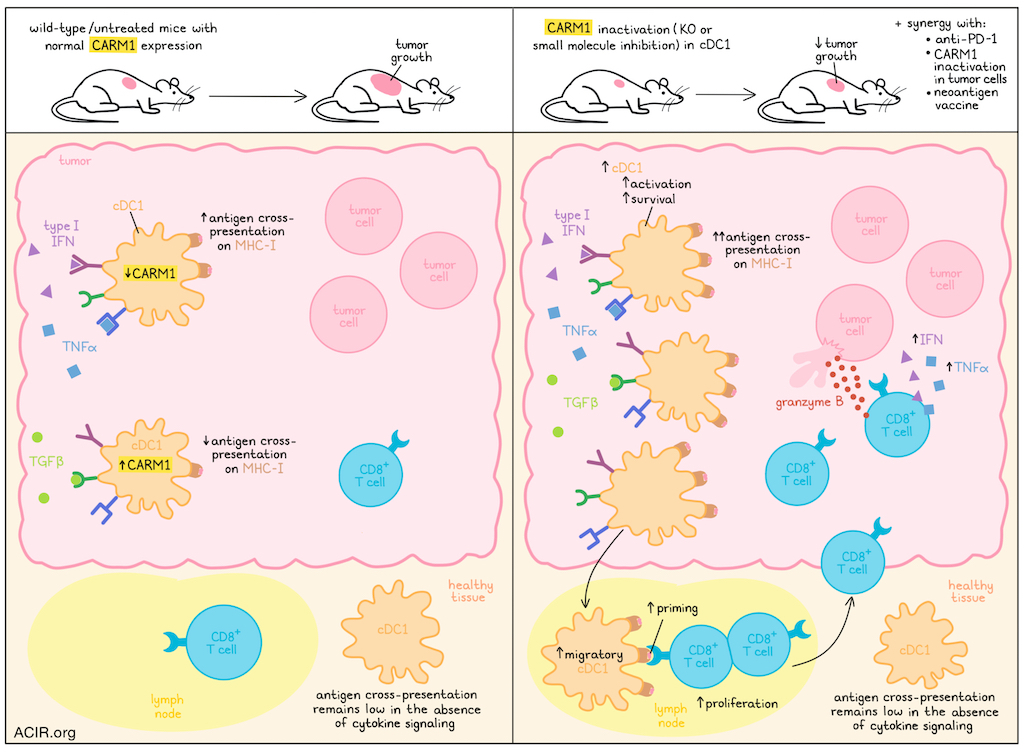
Coactivator-associated arginine methyltransferase (CARM1) is an epigenetic enzyme that controls transcription by methylating arginine residues of chromatin-associated proteins. In previous research, deletion or inhibition of CARM1 in tumor cells enhanced their IFNγ production and sensitized them to T cell-mediated cytotoxicity, while deletion or inhibition of CARM1 in T cells enhanced their effector functions. In work recently published in Science, Zhang et al. evaluated the role of CARM1 in dendritic cells, and found that its deletion or inhibition in cDC1s in tumors enhanced their activation, cross-presentation of antigens, and priming of CD8+ T cells, enhancing antitumor immune responses.
To begin, Zhang et al. co-cultured irradiated B16-OVA tumor cells with bone marrow-derived cDC1s. When Carm1 was knocked out from cDC1s or inhibited using the small molecule CARM1-inhibitor EZM2302, cDC1s showed enhanced cross-presentation and activation of OT-I cells. In mice that had Carm1 expression knocked out in cDC1s, cDC1s showed enhanced antigen cross-presentation of both soluble and endogenously expressed antigens to CD8+ T cells. Meanwhile, in mice with cDC1s engineered to overexpress Carm1, cross-presentation was impaired, and activation of CD8+ T cells was reduced. Similar effects were not observed when CARM1 expression was modulated in cDC2s.
In both control and CARM1-deficient cDC1 settings, cross-presentation remained low in the absence of cytokine stimulation, and in healthy mice, Carm1 inactivation in cDC1s or both cDC1s and cDC2s did not affect the development or standard functions of these cells. However, when the researchers evaluated mice bearing MC38 tumors, they found that Carm1 inactivation in cDC1s substantially slowed tumor growth, to an extent similar to PD-1 checkpoint blockade. Combining Carm1 inactivation with PD-1 blockade further increased infiltration of effector CD8+ T cells expressing IFNγ, TNFα, granzyme B, and Ki67, reduced tumor growth. and extended mouse survival. In mice bearing B16F10 tumors, which are typically resistant to anti-PD-1, Carm1 inactivation sensitized tumors to anti-PD-1.
Based on prior evidence that CARM1 inhibition in tumor cells enhanced their production of type 1 IFNs, which can activate DCs, Zhang et al. hypothesized that simultaneous CARM1 inhibition in both tumors and cDC1s might have a compounding effect. Investigating this, the researchers implanted control-KO or Carm1-KO B16F10 melanoma cells into control mice or mice with Carm1-KO on cDC1s. While Carm1-KO in either cell type led to reduced tumor growth, Carm1-KO in both cell types further reduced tumor growth and extended survival. A cross-presentation assay showed that coculture of Carm1-KO tumors and Carm1-KO cDC1s enhanced activation of OT-I cells, but that this effect was abrogated upon IFNAR1 blockade. These results suggested that the increased type 1 IFN produced by Carm1-KO tumor cells could further enhance the cross-presentation functions of Carm1-KO cDC1s. Further experiments showing the lack of an effect of IFNAR1 blockade in Carm1-KO cDC1s only demonstrated that there were also DC-intrinsic effects of CARM1.
Investigating whether Carm1 inactivation enhances priming in tumor-draining lymph nodes, the researchers found that in MC38-bearing mice with Carm1 deletion in cDC1s, transferred OT-I cells showed increased activation in tdLNs after 24 hours, and increased proliferation after 72 hours, suggesting enhanced early priming.
Next, the researchers looked more closely at how Carm1 inactivation might alter cross-presentation in cDC1s. By incubating cDC1 with fluorescent beads coated with antigen and an antibody to CLEC9a (to mark cDC1s), the team found that while antigen uptake was similar between control and Carm1-deficient cDC1s, Carm1-deficient cDC1s showed enhanced surface display of the OVA peptide SIINFEKL on MHC-I. Similar results were observed for cDC1s cocultured with apoptotic B16-OVA tumor cells. Analysis of bone marrow-derived cDC1s lacking Carm1 expression showed upregulation of genes involved in antigen presentation, including proteasome subunits, TAP, and MHC-I, and upregulation of pathways related to antigen processing and presentation on MHC-I. In MC38-OVA tumor-bearing mice with Carm1-deficient cDC1s, both tumor-infiltrating and migratory cDC1s were increased in tdLNs, and surface display of the OVA peptide SIINFEKL on MHC-I was increased. Together, these results suggest that Carm1 inactivation enables enhanced antigen processing and presentation, rather than enhanced antigen uptake.
Evaluating populations of tumor-infiltrating DCs, Zhang et al. found that the proportion of cDC1s was increased in mice with Carm1-deficient cDC1s or cDC1s and cDC2s. Migration of cDC1s was also enhanced, with increased migratory cDC1s in tdLNs and increased expression of Ccr7. cDC1s were enriched in activated cDC1s, and showed upregulation of DC activation-related genes, including Cd80, Cd86, Il12b, Il1b, and genes involved in MHC-I antigen processing and presentation. Genes related to NF-κB activation and cell survival were also upregulated in Carm1-KO cDC1s, in line with the increased accumulation of cDC1s in tumors. These findings were further supported by pathway analysis and flow cytometry data. Activation markers were also increased in a non-cycling cDC1 population, which showed increased expression of BCL-2 (an anti-apoptotic protein) and reduced apoptosis, suggestive of enhanced survival.
In vitro, type 1 IFN and TNFα induced downregulation of Carm1, while TGFβ upregulated Carm1, dependent on signaling via Smad2/3. Additional inhibitory effects of TGFβ (including reduced cross-presentation) were reduced in Carm1-deficient cDC1s, but were not entirely abrogated with high doses of TGFβ, suggesting that Carm1 upregulation is one of, but not the only mechanism by which TGFβ inhibits cDC1s. Analysis of chromatin accessibility in cDC1s showed that Carm1 inactivation increased accessibility in regions associated with NF-κB and AP-1, and decreased accessibility in regions associated with PU.1:IRF8.
Investigating whether CARM1 could be targeted to enhance immunotherapy, Zhang et al. locally delivered a single low dose of the CARM1 inhibitor EZM2302 incorporated into a neoantigen vaccine targeting MC38-associated peptides. The addition of EZM2302 enhanced recruitment of cDC1s and other antigen-presenting cells to the vaccination site, cDC1 antigen presentation, and cDC1 migration to tdLNs. It also increased neoantigen-specific CD8+ T cells in tdLNs and spleens, and enhanced the antitumor efficacy of the vaccine, resulting in a survival benefit. Similar results were observed in an OVA-based vaccine model.
Finally, the researchers investigated whether their findings in mice might translate to human cDC1s. Using human cDC1s differentiated from hematopoietic stem cells, they found that Carm1 knockout or CARM1 small-molecule inhibition increased expression of activation markers, antigen presentation molecules, CCR7, and CD80/CD86 costimulatory molecules. When human Carm1-KO cDC1s were pulsed with antigen-expressing apoptotic B2M-KO A375 human melanoma cells, they primed stronger NY-ESO-1-specific T cells responses (increased Ki67, activation, and secretion of IFNγ and TNFα) than control cDC1s.
Overall, these results suggest that CARM1 acts as a negative regulator of cDC1s that limits activation, antigen presentation, and migration. Inactivation of Carm1 in cDC1s altered their chromatin accessibility, leading to enhanced functionality in tumors, and resulting in increased CD8+ T cell-mediated antitumor efficacy. When used in combination with a neoantigen vaccine, inactivation of Carm1 enhanced antitumor responses, suggesting its potential to improve current immunotherapies.
Write-up and image by Lauren Hitchings
Meet the researcher
This week, first author Xixi Zhang answered our questions.

What was the most surprising finding of this study for you?
The most surprising finding was how remarkably specific CARM1 is to tumor-infiltrating cDC1s. Deleting CARM1 had little effect on cDC1 development or homeostasis under steady-state conditions, and did not noticeably alter the function of tumor-infiltrating cDC2s. Instead, its impact was highly selective for cDC1s within the tumor microenvironment. Even more strikingly, CARM1 loss did not simply enhance one aspect of cDC1 biology – it fundamentally rewired their functional state. CARM1-deficient cDC1s became more effective at cross-presenting tumor antigens and priming CD8+ T cells while also accumulating in greater numbers within tumors. Together, these findings revealed CARM1 as a novel epigenetic checkpoint that simultaneously controls both the quality and abundance of antitumor cDC1s.
What is the outlook?
One exciting aspect of this work is its translational potential. We found that pharmacological inhibition of CARM1 similarly enhanced the function of human cDC1s. In preclinical models, combining a selective CARM1 inhibitor with a neoantigen vaccine produced encouraging antitumor responses. Together with our previous studies showing that CARM1 also restrains antitumor immunity in tumor cells and CD8⁺ T cells, these findings position CARM1 as a promising therapeutic target across multiple key cell types in the tumor microenvironment. Our ongoing work focuses on determining whether this mechanism is broadly conserved in human dendritic cells across different cancer types, and on advancing CARM1 inhibition toward clinical translation.
Who or what has been a major source of inspiration or motivation for you throughout your career?
My biggest source of motivation has always been the possibility that basic science can eventually make a difference for patients. I find it incredibly rewarding that answering a fundamental biological question today may contribute to better cancer therapies in the future. Along the way, I've also been fortunate to work with my dedicated mentor and talented colleagues who encouraged me to stay curious, think critically, and persevere through setbacks. Those experiences have reinforced my belief that meaningful discoveries come from asking important questions and having the patience to pursue them.


